Tax returns come in different forms: there are quarterly and annual returns, those subject to payment, and those that are purely informative. In the case of forms 303 and 390, the former is the quarterly return for transactions subject to VAT, and the latter is the summary, for information purposes, of the four quarters.
Form 303
Tax form 303 is the quarterly return and payment of Value Added Tax (VAT) to the Tax Authorities on sales invoices. This form is filed quarterly in order to make an installment payment of the taxes declared.
The submission of this form is mandatory for any individual, self-employed person, or legal entity that carries out an economic activity subject to VAT. The submission must be made in the first few days of the month following the end of the quarter, i.e., in the first few days of April, form 303 must be submitted for the activity in January, February, and March.
Failure to file Form 303 will result in penalties from the Tax Agency. If the error is corrected immediately, there is a fixed fine of €100 to be paid with the corresponding taxes. On the other hand, if a notification is received from the Tax Agency, the fine amounts to €300.
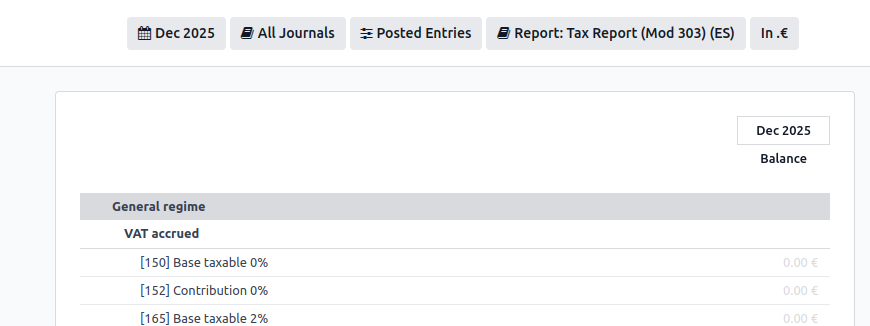
In Odoo, the amount of each sales invoice sent will be automatically reflected in form 303. You will find the base amounts and the proportional VAT amount within the form. This form will be ready for export and submission to the Tax Agency portal. You will see the total amount of tax payable at a glance.
Form 390
Form 390 is the annual summary of the four Form 303s, one for each quarter. This form will show all income from sales invoices. Therefore, the total amount on Form 390 must be equivalent to the sum of the four Form 303s submitted throughout the year.
The main difference between the two forms, apart from when they are filed, is that Form 390 is for informational purposes only, i.e., no payment is associated with its filing.
Form 390 must be submitted by the same legal entities or self-employed persons as form 303, so any economic activity must be recorded. In this case, the deadline for submission is during the month of January of the following year. For example, to submit form 390 for economic activity in 2025, it must be done between January 1 and 30, 2026.
In the case of penalties, if form 390 is not submitted on time or at any time, they will range from a minimum of €300 to a maximum of €20,000.
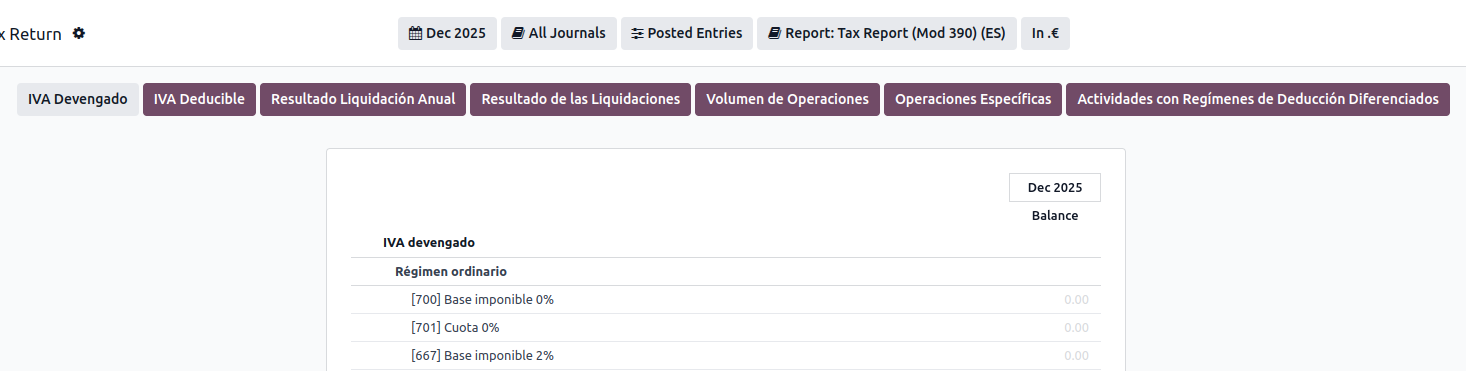
Just as with Form 303, Odoo will directly transfer the data to the corresponding fields on Form 390, allowing you to export the file for submission and see the total amount at a glance, so you can quickly check whether the amounts on the four Form 303s and Form 390 add up.
Form 347
In Spain, the real estate rental and sale industries must file Form 347 with all the information about the characteristics of the property. This must be done for each transaction exceeding €3,005.06 in the corresponding calendar year. No distinction is made in the nature of the transaction, and deliveries and acquisitions of goods and services are calculated separately.
Form 347 is not exclusive to the sale or leasing of real estate, which is why Odoo has developed a specific version for real estate companies. Form 347 must be submitted by:
Natural or legal persons (both commercial companies and other entities) that carry out professional or business activities.
Entities without legal personality mentioned in Article 33 of the LGT (communities of property, undistributed estates, civil partnerships, separate estates).
However, as mentioned above, when it comes to a rental service or a sale exceeding €3,005.06, a more extensive version of form 347 must be submitted, with detailed information about the property or properties in question.
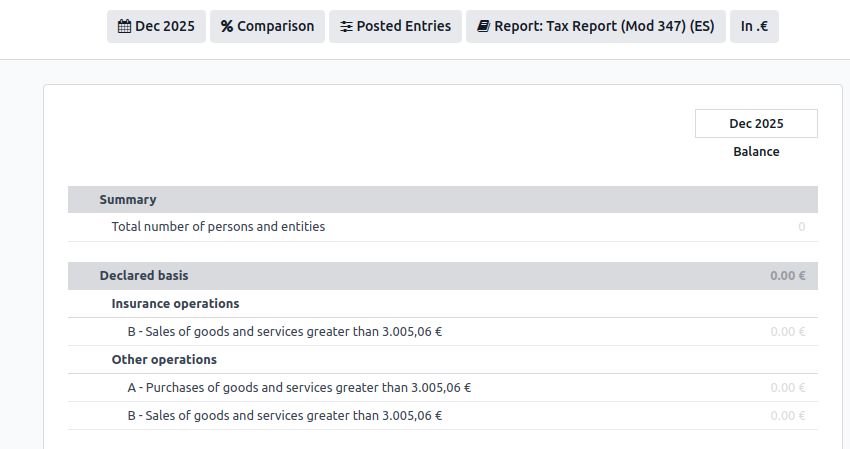
In the case of real estate agencies, form 347 must be submitted with additional information. To this end, Odoo has developed the Real Estate module, called “Spain - Real Estate,” which is accessible through Odoo applications and has been developed to include the specifications of tax form 347. It is important to download this module first, as it is not automatically downloaded with the Spanish tax package.
With the module installed, we will see the adaptation for form 347 in two ways: on the one hand, when issuing an invoice and, on the other, from the form itself.
When creating an invoice, we add the customer, a billing line for the sale or lease of the property, and then we access the AEAT tab. There we will now see a Type box for form 347, where we must select “Real estate operation.” Once we have added this, a second line will appear in which to create the property. The mandatory fields for submitting the form will also be mandatory in the Odoo form.
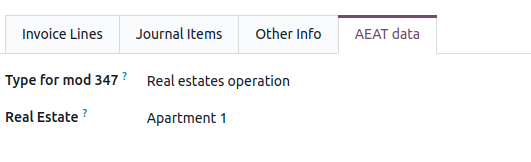
For each property we rent or sell, the above steps must be followed. On the other hand, we can now access the tax forms and see how this has affected us.
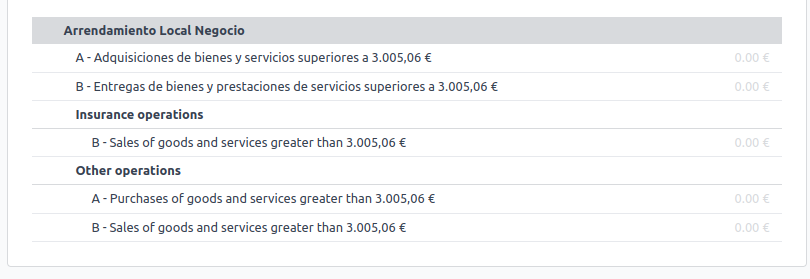
To do this, we open our accounting application, go to the reports tab, and access the tax forms section. We select form 347 and see how this version contains much more information than we had previously. This includes all the information on the real estate properties that we have been creating in our invoices.
By following these steps, form 347 will be completed automatically and will be ready for submission to the Tax Agency when the time comes.
Form 349
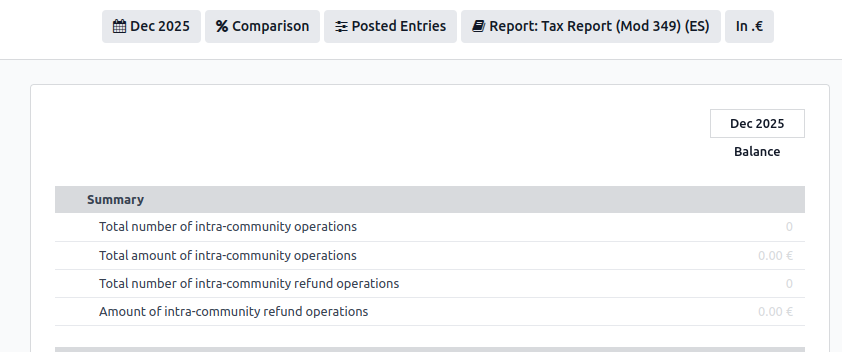
Form 349, like form 390, is for information purposes. In this case, it is a monthly or quarterly submission of all intra-Community transactions carried out by both a company and a self-employed person who carries out this type of transaction.
In this case, the penalties are the same as for form 390, with a minimum of €300 and a maximum of €20,000. The exact amount within this range is calculated at €20 for each piece of data or set of data omitted from the submission.