At a glance:
Trapped in a fragmented software jungle of Airtable, Zoho, and LexOffice, Swiss AgeTech pioneer CARU AG needed a unified solution. By transitioning to Odoo, the creators of CARU care eliminated data silos, automated their financial and manufacturing workflows, and achieved a 100% efficiency boost to fuel their B2B2C expansion.
Company Name: CARU AG
Hosting Type: Odoo.sh
Apps: Inventory, Purchase, Sales, Manufacturing (MRP), CRM, Accounting, Maintenance

CARU is a leading AgeTech company based in Zurich and Lübeck. Since its foundation in 2017, CARU has been enabling independent living in old age with innovative solutions, reinventing the traditional emergency call system.
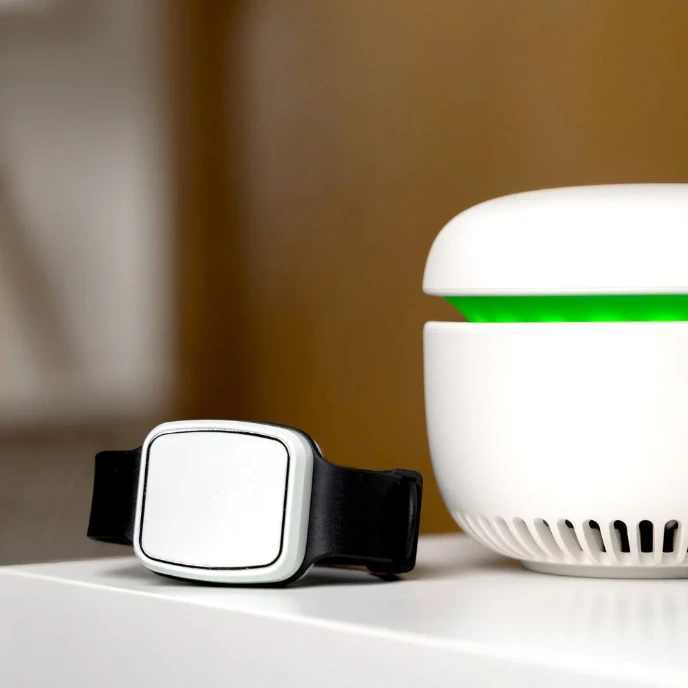
The thoughtfully designed emergency call solution, CARU care, eases the daily lives of elderly individuals, their relatives, and caregivers. The design and user interaction of CARU care have already won multiple awards. CARU care is developed and produced in Switzerland. In addition to ensuring the highest product quality, this allows CARU to develop new solutions in close cooperation with its customers and partners, and to guarantee fast, competent support.
The downside of growth: When legacy software holds back business goals
Before introducing Odoo, CARU AG relied on a "Best-of-Breed" approach: Airtable for manufacturing, LexOffice for accounting, Shopify for e-commerce, and Zoho as a CRM. What began as a selection of the best individual tools ended up in a fragmented system landscape. Painful media disruptions and an enormous amount of manual data maintenance increasingly hindered growth. The challenge of existing systems not communicating with each other wasted valuable resources and severely stalled expansion. To achieve the company's goals, a unified software solution was urgently needed.
Before selecting a new ERP system, two areas were identified as the sources of the greatest problems:
Supply Chain & Manufacturing
Here, the lack of integration in the legacy software was particularly noticeable, leading to highly confusing situations:
No Revision Control: Real revision control for assemblies was not possible with the old system. Workarounds were error-prone, difficult to maintain, and completely user-unfriendly.
Complex Tracking: Tracking batches and serial numbers was extremely complex and barely worked in practice.
Inventory Chaos: Booking material in and out across different warehouse locations was complicated and highly error-prone.
Inefficient Purchasing: Creating purchase orders took up a massive amount of time and was not scalable in the long run.
Isolated Data: There was no connection to critical external databases like AWS or Zoho, making it impossible to see which customer owned, ordered, or returned which devices.
Hardware Disconnect: Hardware such as label printers could not be connected to Airtable.
Finance & Reporting
In accounting, there was a severe lack of live reporting, which is central to correctly assessing the current business situation:
Manual Forecasts: Sales reporting and cash flow forecasts relied on manually collected data, which had to be transferred by hand into various spreadsheets.
Slow Payment Processing: Processing credit card payments was a very lengthy process due to manual reconciliation.
Down Payments: Customer down payments had to be monitored manually.
Deffered Revenue: Accruals were painstakingly maintained in separate spreadsheets and reconciled by hand.
The result was a massive time lag. Financial reports always showed the past rather than serving as a basis for future-oriented decisions. To achieve ambitious business goals, it was clear: CARU needed a Single Source of Truth.
Autonomous implementation – supported by experts
CARU AG decided on a self-reliant implementation, accompanied by the advisory support of an Odoo Business Advisor. The strategic guideline was to stick strictly to the standard version of Odoo initially and to get to know the various modules step-by-step in a test environment.
Another deliberate decision was the implementation of effective change management. Before the project was officially presented to the entire workforce, individual face-to-face meetings were held with the affected team members. This allowed key users from Sales and Finance to be specifically engaged by demonstrating the concrete added value for their daily work. Concerns within the team – such as the worry that individual employees might be pulled too heavily away from daily operations – were also proactively addressed.
Following the preparation phase, the company transitioned to a phased implementation:
Phase 1 – Preparation & Testing: First, core processes were configured and extensively tested in a staging environment. A major focus was placed on defining a "Single Source of Truth" for data and preparing the data import from legacy systems.
Phase 2 – Initial Rollout: The first go-live focused on essential core areas: Finance, Inventory/Warehouse Management, Manufacturing, and Sales. To reduce complexity, other modules such as expense management, payroll, and CRM were intentionally excluded from the initial rollout and moved to the backlog.
Phase 3 – Go-Live & Stabilization: In January 2025, the company went live with a "Minimum Viable Product" (MVP). With this approach, not all functions were active yet, and legacy systems partially ran in parallel. Step by step, the focus shifted to phasing out the old software.
The advantage of this approach: The team could gather experience with the new system step-by-step, identify issues, and adapt or adjust settings as needed.
Breaking isolation – with a fully integrated software solution
Odoo significantly helped the company overcome the original fragmentation of its system landscape by serving as a central hub for all interconnected business processes.
End of Data Silos and Improved Data Analysis
Instead of isolated data silos in tools like Airtable, Zoho, or Lexoffice, Odoo offers an integrated solution that has drastically reduced the manual effort required for data consolidation. Employees no longer need to act as "human interfaces" to painstakingly merge data by hand.
Thanks to Odoo, a single, continuous flow of information now exists, seamlessly linking data from the marketing funnel, CRM, warehouse, purchasing, sales, finance, and projects. This allows for far better cross-departmental data analysis and enables the generation of meaningful reports directly from the system without manual intermediate steps.
Efficiency Gains and Scalability
In the finance department, time-consuming workflows were automated. B2B service fee invoicing is now much more efficient, as active devices are automatically pulled by the system for billing. Deferred revenues (accruals) can now be created automatically during invoice posting, replacing error-prone manual preparation in separate spreadsheets. Odoo integrates and automates core financial processes, increasing accuracy and freeing up resources for company growth. Overall, efficiency in invoicing was doubled.
In supply chain and manufacturing, Odoo replaced the limitations of Airtable with a fully functional serial number tracking system. The integration of warehouse, production, and sales enables a seamless flow of information, meaning purchasing and incoming orders are no longer disconnected from controlling. This "Single Source of Truth" reduced operational error rates and massively improved scalability across the entire supply chain. The entire material flow—from purchasing and warehousing to production and sales – now runs much more smoothly and efficiently with lower error rates. Here too, CARU AG reports a 100% increase in productivity. This boosted efficiency is the prerequisite for expanding in the B2B2C segment.
Cultural Change
Thanks to Odoo's user-friendly interface and intuitive operation, CARU AG was able to carry out parts of the implementation independently. They received support from an Odoo Business Analyst; consulting hours were purchased as part of a Success Pack and utilized as needed.
With this expertise backing them up, a "Do-It-Yourself" implementation was possible. This not only resulted in deep expert knowledge among all employees but also fostered a high degree of personal responsibility within the workforce. A sense of ownership among everyone involved is a central building block of transformation projects – and Odoo's architecture made this achievable.