Turning EOFY Stress Into Momentum
Congratulations. You made it.
The clock struck midnight on June 30, the frantic rush to close the books subsided, and Australian business owners successfully dragged their business across the financial year finish line. If you're in New Zealand, your own EOFY crunch back in March is still fresh enough to remember and July's arrival means the pressure of a new sales quarter is just beginning.
Whether you are managing a bustling retail network, running a trade distribution centre, or coordinating a complex fabrication workshop... you deserve a moment to catch your breath.
But let’s be entirely honest with ourselves before the memory fades. At what cost did you make it through?
How many late nights did you or your finance team spend hunched over laptops, manually reconciling data across disconnected spreadsheets? How many missing Sales Orders had to be tracked down across separate platforms? How many hours vanished into the void while you desperately tried to figure out why your independent eCommerce store, your standalone point-of-sale terminal, and your cloud accounting package didn't reconcile with your actual year-end inventory values?
At the end of every financial year, a familiar vow echoes across the AU/NZ business landscape: “Next year will be different. I am going to automate this mess.”
Yet, as the immediate stress of tax season passes, day-to-day operations take over. The friction points that felt intolerable in June become background noise by September. If you want a genuinely seamless, automated, and stress-free financial year for 2026/2027, the smartest time to act is right now.
1. The Post-EOFY Reality Check: Diagnosing the "Software Hangover"
If your business relies on a collection of disconnected, best-of-breed applications held together by third-party APIs and digital duct tape, you likely experienced the classic symptoms of a software hangover:
🔍 The Inventory Disconnect: Your physical warehouse numbers didn't match your front-end e-commerce store, leading to awkward customer refunds or backorders during peak end-of-financial-year (EOFY) sales.
⏳The Sync Lag Nightmare: Transactions from your point-of-sale (POS) systems or field service apps often depend on scheduled or manual syncs rather than live updates, leaving your cash flow visibility clouded for hours or longer depending on your setup.
📉The Spreadsheet Bureaucracy: Your admin team spent days exporting CSV files, cleaning data in Excel, and manually re-importing files just to reconcile cost of goods sold (COGS).
This isn't just an administrative annoyance; it is a massive, hidden drain on your profitability. The time spent fixing data mismatches is time stolen from strategic growth, customer acquisition, and operational improvement.
2. The Danger of the
When a system breaks during the end of the financial year rush, the natural human reaction is to patch it quickly so you can keep moving. You install another connector plug-in, build a new intermediary spreadsheet, or hire a temporary admin worker to handle the data entry backlog.
Trying to fix a fundamentally disconnected system (often referred to as a "Frankenstein stack") by adding more point solutions only delays the inevitable. Every new plug-in introduces another potential point of failure. When a mainstream e-commerce platform changes its API policies, or an isolated inventory app pushes a background update, the fragile digital bridge connecting them to your core accounting software collapses.
By letting the frustration of last month fade without addressing the root cause, you are unconsciously signing up for an identical crisis in 2027. The best time to fix a broken system was yesterday. The second best time is right now.
3. Why July is the Golden Window for ERP Migration
Migrating your core business operations to an Enterprise Resource Planning (ERP) platform like Odoo gives you a single source of truth across your business, replacing disconnected systems with a single integrated platform. By timing your transition to coincide with the start of the fresh financial year, the process becomes even more seamless right from the start.
Here is why July is one of the strongest strategic windows for system migration:

Clean Data Cutoff
Data migration is a standard milestone in any system upgrade, but doing it now offers a distinct operational advantage. If you change systems mid-year, you have to transition active, mid-transit ledgers and ongoing inventory calculations. For Australian businesses, July is the moment your historical books have just been finalised and closed off — a clear line in the sand. For New Zealand businesses, that same clean cutoff happened back in March, which means your books have now had a few months to settle, with any post-close adjustments already resolved. Either way, once opening balances have been confirmed and closing stock takes verified, you can import your finalised data into Odoo, which greatly reduces historical overlap and simplifies data migration.
Months to Master the Platform
Upgrading to Odoo is an exciting step forward that naturally brings a fresh rhythm to your day-to-day operations. Implementing the platform in July gives your warehouse teams, counter staff, procurement officers, and accountants a brilliant, low-pressure runway to establish their new routines. They get a full year to build confidence, optimise their day-to-day workflows, and enjoy the benefits of automation long before the next EOFY rolls around.
Aligned Financial Reporting
Your new financial year's reporting history — FY26/27 for Australian businesses, FY27 for New Zealand businesses — resides inside one unified environment from day one. When you look back to analyse your business performance down the road, you get a beautiful, uninterrupted view of your growth. Having all your data in one place means your end-of-year comparisons are clean, consistent, and ready for strategic decision-making at a glance.
4. What Next Year Could Look Like With a Single-Database Architecture
Moving away from a disconnected system to a unified platform like Odoo changes the rhythm of your business, shifting your focus from daily manual fixes to smoother, more automated operations.
Inventory & Valuation
The Old Fragmented Way
Sync schedules cause delays; stock values must be manually cross-referenced with the balance sheet.
The Odoo Unified Way
With perpetual inventory valuation configured, Odoo automatically posts inventory valuation and cost-of-goods-sold accounting entries, helping keep your inventory and financial records aligned while reducing manual reconciliation.
Sales & Accounting
The Old Fragmented Way
Invoices and retail sales must be pushed via API connectors, potentially causing dropped or duplicated entries.
The Odoo Unified Way
Sales transactions natively live in the same database as your general ledger; accounting entries can be generated automatically without third-party connectors.
Compliance & Tax
The Old Fragmented Way
Manually compiling GST returns, BAS (Australia), and end-of-year financial reports by extracting data from multiple software dashboards and reconciling mismatched figures.
The Odoo Unified Way
Automatically generates the transaction data needed for Australian BAS and New Zealand GST reporting, with bank reconciliation tools that help match payments against tax liabilities — reducing manual data preparation ahead of lodgment with the ATO or IRD.
But the real power of moving to a unified, live-data environment extends far beyond saving time on internal paperwork: it completely transforms how financial institutions look at your business.
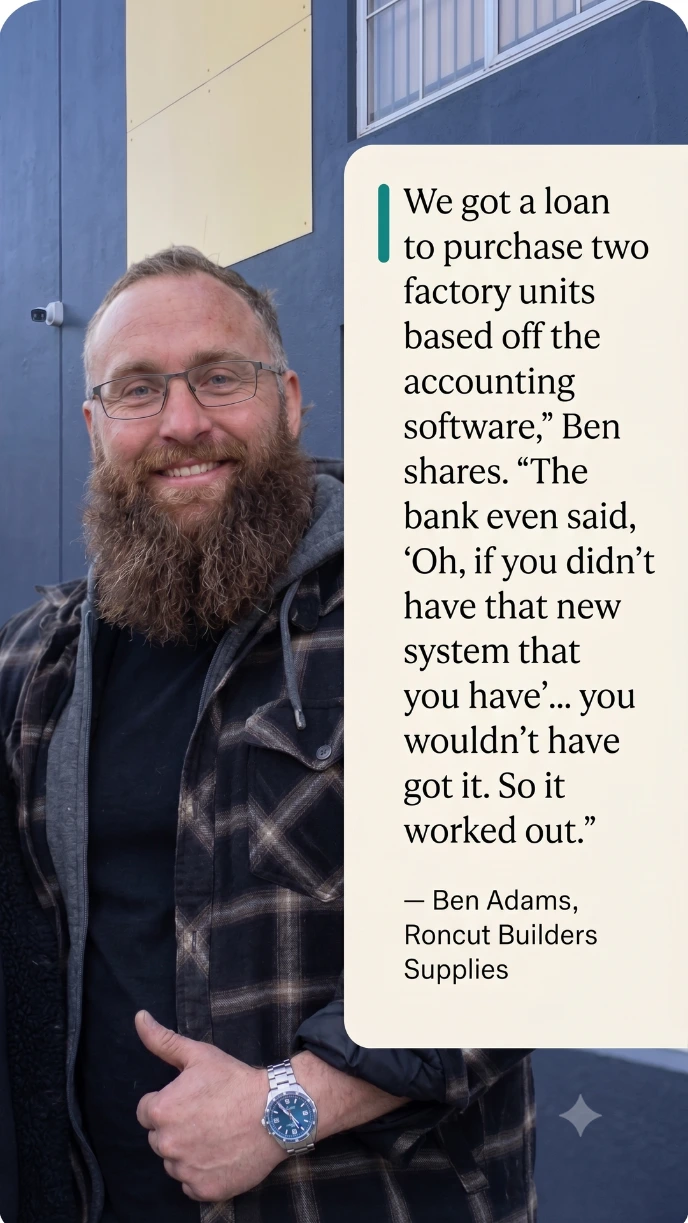
Roncut Builders Supplies
Ben Adams from Roncut Builders Supplies experienced this exact strategic shift after moving his operations over to Odoo. When it came time to scale his physical footprint, having unified, credible financial data changed the game with his lenders.
When your software architecture is clean, you aren't just making tax season easier: you are building a highly credible foundation for real commercial leverage, funding, and rapid expansion.
Frequently Asked Questions
For Australian businesses, July aligns perfectly with the absolute start of the new financial year, allowing you to migrate data with freshly finalised books. For New Zealand businesses, July marks the start of the second quarter of New Zealand's financial year, making it an excellent time to upgrade systems before year-end pressures and the busy summer trading period.
Fragmented setups rely on API syncs between separate apps (like standalone POS, e-commerce, and accounting systems), which can frequently lag or drop data. A single-database platform like Odoo natively links your Inventory, Point of Sale, Purchases, and Accounting. With real-time (perpetual) inventory valuation configured, the financial ledgers and stock values update concurrently as transactions happen — minimising the need for stressful, manual end-of-year data cross-checking.
Standard cloud accounting packages are fantastic tools for managing general ledgers, payroll, and core business financials. However, they aren't inherently designed to manage complex warehousing operations, multi-channel manufacturing, or deep Bill of Materials (BOM) paths.
The clear sign that your business is ready to graduate to an integrated platform like Odoo isn't that your current software is failing you—it's that your operational complexity has outgrown it. If your team is regularly using external spreadsheets or separate third-party add-ons just to calculate landed costs, track physical stock movements, or monitor raw materials before manually entering those numbers into your accounting system, you have naturally evolved into the ERP space.
Not Ready to Upgrade Today? for Tomorrow
Every business has different priorities, resources, and timelines. While the start of a new financial year can provide a natural opportunity to improve your systems, it is not the only time to take the first step.
Odoo is designed to grow with businesses of all sizes, providing an affordable and flexible way to bring your operations together as your needs evolve. Even if a system change can’t happen today, exploring what’s possible can help you identify where automation, better visibility, and connected workflows could make an impact.
Start your free Odoo trial to experience how a unified platform can simplify your day-to-day operations and help you understand what your business could achieve with the right tools in place.
Take Control of Your New Financial Year
The relief of surviving the end of the financial year shouldn't distract you from the cracks that appeared in your systems last month. The stress, the lost hours, and the operational blind spots were a warning sign.
Don’t wait until next May to start stressing about your software stack all over again. Take advantage of the clean slate that July provides.
Book a live Odoo consultation with an expert today, and set your business up for a streamlined, highly automated, and profitable financial year.